Wiring
WARNING!
| • | An approved electrician must do electrical wiring. |
| • | All wiring must satisfy the requirements of the applicable NEC, CEC, and local electrical safety codes. |
| • | Install a conduit seal within 18 in. (46 cm) of the device enclosure. |
| • | Make sure that all wiring is applicable for use at an ambient temperature of 199.6ºF (93.1°C). |
| • | Before installing the wiring for the device, disconnect the power source. |
| • | Read all electrical warnings and wiring requirements before connecting power to the device. |
| • | In order to maintain the environmental and hazardous area ratings of the detector, install conduit adapters or plugs in the enclosure per applicable agency requirements. |
| • | The device wiring can be damaged by electrostatic discharge (ESD). When you do work with the device wiring, be careful to touch only the connection points. The warranty does not supply coverage for components that are damaged by ESD. |
| • | Do NOT install wiring in a hazardous atmosphere. Otherwise, electrical shock or ignition can occur. |
Failure to follow these warnings can result in serious personal injury or death.
Install all wiring connections through the base entries to the terminal block (TB). The terminal block accepts 14 - 22 AWG (2.1 - 0.3 mm2) stranded or solid-core wire.
If conduit is used, to prevent corrosion in the housing due to moisture or condensation, a drain loop in the conduit is recommended.
For enclosure entry points, a non-hardening sealant should be used on threads.
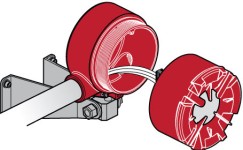
Figure 15 FL500 Housing and Base
Remove the insulation from each wire to 0.25 in. (0.64 cm).
Use the correct cables for the ambient temperature where the device is installed.
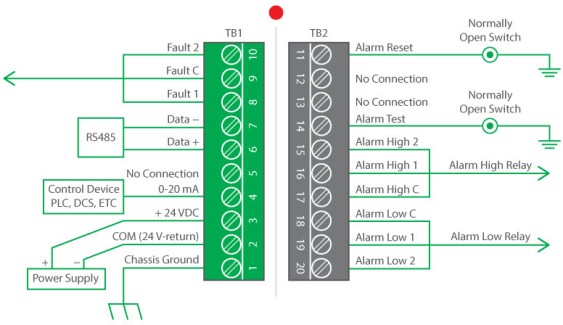
Figure 16 Wiring Diagram
Protection Circuits for Relay Contacts
WARNING!
Protect relay contacts from transient and over-voltage conditions. Attach a clamp to all inductive loads (bells, buzzers, relays) on dry relay contacts as shown. Inductive loads that do not have a clamp attached can cause voltage spikes of more than 1000 Volts. Voltage spikes of this magnitude can cause false alarms and damage to the contacts.
Failure to follow this warning can result in serious personal injury or death.
| 1. | To connect the wire to the terminal block, install the conductor in the connection space as shown. |
| 2. | Use a flat-blade screwdriver to tighten the related screw terminal. |